
 David Victor
Updated September 2026
Here’s a number most people in this business have never seen. When the original act is gone for good, a tribute band can charge more for a ticket. Researchers who studied German tribute concerts found show prices run about 11% to 15% lower while the original act still exists, all else equal (Samuel Cameron and Hendrik Sonnabend, Economics Bulletin, Apr 2020). That’s public ticket prices from 2015 to 2019, not private booking fees, but the direction is hard to miss.
The same paper found that when the original is out touring, tribute tickets rise by about 9% compared with originals that aren’t (Samuel Cameron and Hendrik Sonnabend, Economics Bulletin, Apr 2020). Scarcity sets the price. So does buzz.
The demand behind all this is big. About 159 million fans went to a Live Nation show worldwide in 2025, the company’s largest count ever (Live Nation Entertainment, Feb 2026). Deep catalog made up 75% of all rock audio streaming in the first half of 2026 (Luminate, Jul 2026). And the Eagles hold the longest residency in Sphere’s history, with 58 shows scheduled through April 2026 (Sphere Entertainment Co., Feb 2026).
My pedigree was that I was a recording and touring member of the multiplatinum band BOSTON, and I vet every act on this site, so I care about these songs for a living. If you book for a performing arts center, a casino, a fair, a concert series, a corporate event or a wedding, these are the numbers behind your decision.
Every figure on this page comes from the organization that produced it, carries its date, and gets refreshed monthly. No secondhand numbers. Want the backstory first? Read the complete history of tribute bands.
Key Takeaways
- “Other” live performances, meaning rock, folk and country concerts, comedy and similar shows, rose from 15.0% to 21.2% of U.S. adults between 2017 and 2022, the only performance category to grow (National Endowment for the Arts, Aug 2025).
- The biggest gains in those shows came from adults 35 to 44 (+11.5 points) and 25 to 34 (+9.5 points) (National Endowment for the Arts, Aug 2025).
- The consumer price index for admission to movies, theaters and concerts rose 2.6% from August 2025 to August 2026 (U.S. Bureau of Labor Statistics, Sep 2026).
- The median hourly wage for U.S. musicians and singers was $47.80 in May 2025 (U.S. Bureau of Labor Statistics, May 2025).
- People at nonprofit arts and culture events spend $38.46 per person per event beyond the cost of admission (Americans for the Arts, Oct 2023).
- Las Vegas visitors who paid for shows spent an average of $322.24 on shows and entertainment per trip in 2024 (Las Vegas Convention and Visitors Authority, Mar 2025).
- 29% of the U.S. population attends a fair each year, more than Major League Baseball and NFL attendance combined (International Association of Fairs and Expositions, Sep 2025).
- Improving attendee experience with more memorable events is meeting professionals’ No. 1 priority for the second year running (American Express Global Business Travel, Oct 2025).
- The average live wedding band costs $4,500, compared with $1,800 for a DJ (The Knot, May 2026).
- Only 12% of couples hire a live band for the reception, while 71% hire a DJ (The Knot, May 2026).
How big is the live music audience right now?
Live music isn’t shrinking. It’s shifting toward the rock, country and popular shows tribute acts play, while the formal arts lose ground.
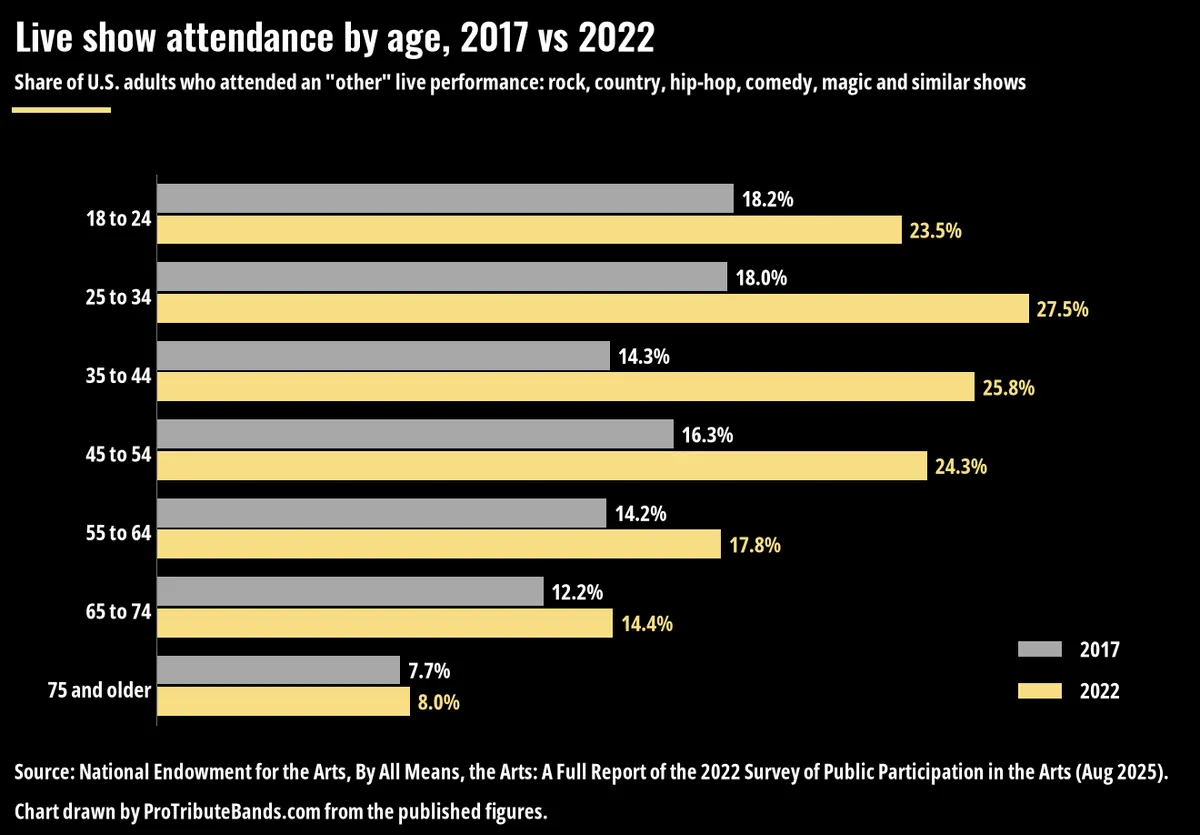
Figure 1: Attendance at “other” live shows climbed in every age group from 2017 to 2022, and the jump was steepest for adults 25 to 44. Source: National Endowment for the Arts, By All Means, the Arts: A Full Report of the 2022 Survey of Public Participation in the Arts , Aug 2025 (2017 and 2022 survey data). Chart drawn by ProTributeBands.com from the figures the source published, 30 Sep 2026.
How many people go to live concerts?
Live Nation drew a record 49 million fans in the second quarter of 2026 alone, up 10% on the year (Live Nation Entertainment, Jul 2026). These are global figures from one company. Treat them as a pulse, not a U.S. headcount.
Still, the scale is real. Live Nation connected fans to over 11,000 artists at 55,000 events in 2025 (Live Nation Entertainment, Feb 2026). Ticketmaster moved 646 million tickets through its systems that year (Live Nation Entertainment, Feb 2026). That count covers every kind of ticketed event, not just concerts.
One detail matters for U.S. buyers. For the first time, more than half of Live Nation’s 2025 fan count came from outside the United States (Live Nation Entertainment, Feb 2026). And 2026 is running hotter. More than 143 million tickets had sold by mid-July, over 14 million ahead of the prior year’s pace (Live Nation Entertainment, Jul 2026).
Which kinds of live shows are growing?
Rock, country and similar popular shows were the only live category that grew between 2017 and 2022. Nothing else grew. Overall attendance at live, in-person arts performances fell 4.3 percentage points over those five years (National Endowment for the Arts, Aug 2025).
Classical music fell hard. Its audience shrank from 11.6% of U.S. adults in 2002 to 4.6% in 2022 (National Endowment for the Arts, Aug 2025).
Festivals are big business too. Live Nation produced 131 festivals worldwide in 2025 (Live Nation Entertainment, Feb 2026). The money side is growing. Inflation-adjusted value added from U.S. performing arts grew 3.5% in 2023 after growing 24.9% in 2022 (U.S. Bureau of Economic Analysis, Apr 2025). The NEA’s “other” category also includes comedy, magic and circus, so read it as popular live shows broadly, not rock alone. There’s more on who’s buying in our look at shifting tribute band audiences.
Who is in the audience for classic hits?
Younger adults, not retirees. Radio tells the same story. Classic Hits grew its share among listeners 18 to 34 from 5.1% to 5.4% in the first quarter of 2026 (Nielsen, Jun 2026).
Among adults 25 to 54, Classic Rock is the No. 2 radio format with an 8.1% audience share, behind Country (Nielsen, Mar 2026). Only Country ranks higher. In my experience, that’s also the age band booking company parties and weddings.
And they’re still tuning in. AM/FM radio reaches 89% of U.S. adults 18 to 34 every month (Nielsen, Mar 2026). Radio numbers measure listening, not ticket buying, so I keep them apart from attendance. But when a 30-year-old hears “Don’t Stop Believin'” on the way to work, you already know what gets them on the dance floor.
Is classic-hits demand still growing?
The songs tribute bands play aren’t a nostalgia niche. Not even close. They’re most of what rock fans stream, and the acts that wrote them still sell out residencies.
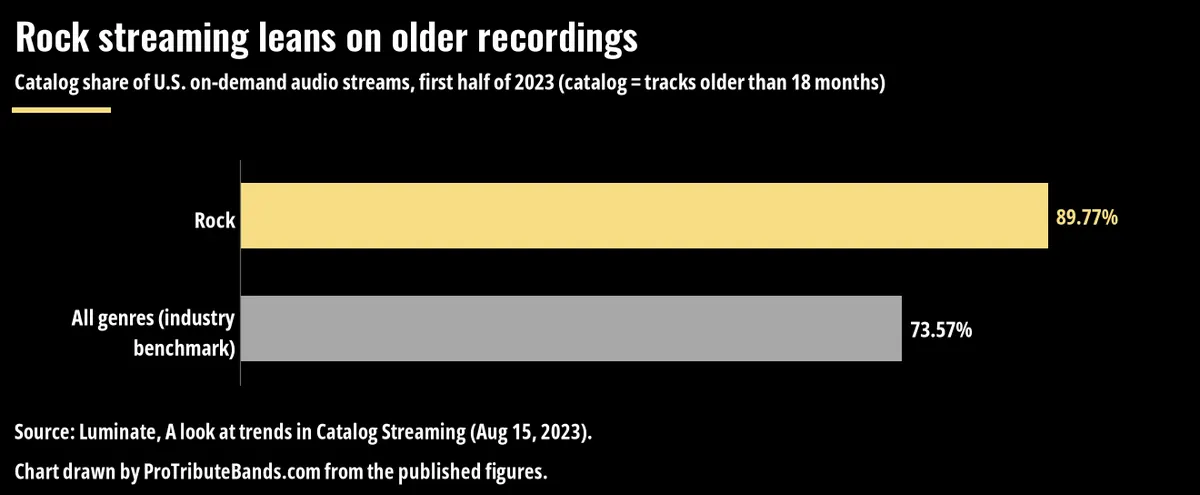
Figure 2: Rock fans stream older recordings far more than the market as a whole, which is the audience a tribute act plays to every night. Source: Luminate, A look at trends in Catalog Streaming , Aug 2023 (first half of 2023 data). Chart drawn by ProTributeBands.com from the published figures, captured 30 Sep 2026.
How much of what people listen to is older music?
Most of it, for rock fans. In the first half of 2023, 89.77% of U.S. on-demand rock streaming was catalog, meaning recordings older than 18 months, against a 73.57% benchmark for all genres (Luminate, Aug 2023).
That’s a different, broader cut than the 2026 “deep catalog” figure up top, which covers older music still. Don’t read them as a trend. They’re two views of the same habit.
Radio keeps those songs in rotation for almost everyone. AM/FM radio reaches 93% of all U.S. adults each month (Nielsen, Mar 2026). Put those together and you get a crowd that already knows every word before the band walks on. That’s the crowd the best classic rock tribute bands play to in towns the original acts rarely reach.
Are legacy acts still drawing crowds?
Yes, big ones. The originals are still pulling huge numbers wherever they can play. Dead & Company completed 48 shows at Sphere across 2024 and 2025 (Sphere Entertainment Co., Feb 2026). U2 opened the venue on September 29, 2023 and played 40 shows through March 2024 (Sphere Entertainment Co., Feb 2026).
Stadiums tell the same story. Live Nation reported its highest-ever volume of stadium shows in 2025 (Live Nation Entertainment, Feb 2026).
These are show counts, not grosses. Scheduled counts can change after a filing, too. They still matter to a buyer. A residency parks a legend in one city for months, and fans everywhere else still want that music. That’s the gap a great tribute fills. If you’re weighing acts, see our rankings of the best Eagles tribute bands, the best Grateful Dead tribute bands and the top-rated U2 tribute bands.
What do tribute shows and live music cost?
Tribute pricing follows scarcity. The fewer chances a fan has to see the original, the more a great tribute is worth, and everything underneath the fee, from musician wages to ticket inflation, is public data.
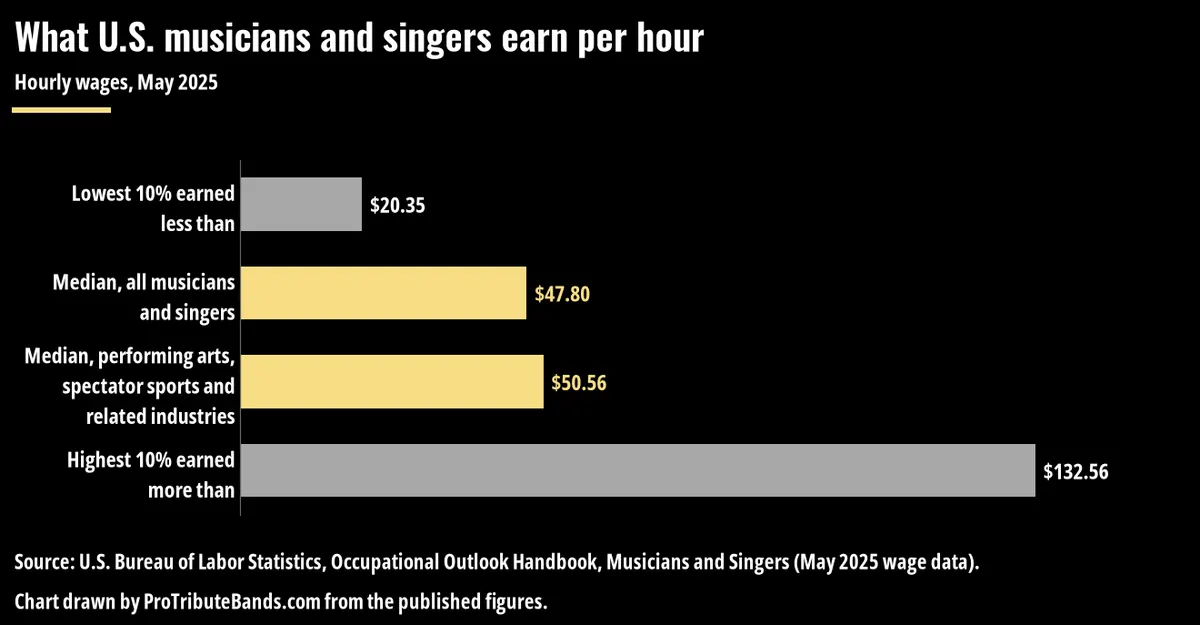
Figure 3: The median musician earns under $50 an hour for performance time, and the gap between the bottom and top tenth is more than sixfold, which is why the act you pick matters. Source: U.S. Bureau of Labor Statistics, Occupational Outlook Handbook: Musicians and Singers , May 2025 wage data. Chart drawn by ProTributeBands.com from the published figures, captured 30 Sep 2026.
What do tribute shows charge, and why?
Tribute tickets cost more once the original act is gone, and more again while it’s touring. The data backs it up. A peer-reviewed pricing study of the sector covered 757 tribute concerts by 155 acts in 333 venues across 251 German cities from 2015 to 2019 (Samuel Cameron and Hendrik Sonnabend, Economics Bulletin, Apr 2020).
It’s one study, in one country, on public ticket prices. Keep that in mind. The average tribute ticket in that German sample was about EUR 25, ranging from EUR 10 to EUR 62.50 (Samuel Cameron and Hendrik Sonnabend, Economics Bulletin, Apr 2020). Weekends ruled the calendar, with 79.52% of shows booked on a Friday or Saturday (Samuel Cameron and Hendrik Sonnabend, Economics Bulletin, Apr 2020).
Travel pays, too. Shows by acts from outside Germany tended to cost more, which the authors put down to the more popular acts being the ones that tour abroad (Samuel Cameron and Hendrik Sonnabend, Economics Bulletin, Apr 2020). That matches what I see on the booking side. The acts worth flying in are the ones buyers ask for by name. For the money side of running one, read the economics of tribute bands.
What our roster costs. ProTributeBands.com roster acts start from $12,500 for a routed date, when the band is already touring nearby, and from $17,500 for a one-off flyout date. The buyer also covers travel, lodging and meals. These are our own starting rates, not an industry statistic. See the full breakdown in how much tribute bands cost.
How fast are live-event ticket prices rising?
Slower than everything else. Prices for all items rose 3.4% over the 12 months to August 2026, faster than live-event admissions did (U.S. Bureau of Labor Statistics, Sep 2026). That admissions index blends movies, theaters and concerts, so it’s a rough gauge for music alone.
The biggest promoter says the same. Live Nation reports low- to mid-single-digit price increases at stadiums, arenas and amphitheaters, with U.S. get-in prices trailing inflation over five years (Live Nation Entertainment, Jul 2026).
Households still budget for fun. U.S. households spent an average of $3,609 on entertainment in 2024, down 0.7% from 2023 (U.S. Bureau of Labor Statistics, Dec 2025). Entertainment made up 4.6% of average household spending that year (U.S. Bureau of Labor Statistics, Dec 2025). If you’re planning a season, our event budget guide walks through the line items.
What do professional musicians earn?
Modestly, and nearly half work for themselves. Musicians and singers held about 170,400 jobs in the U.S. in 2025 (U.S. Bureau of Labor Statistics, May 2025). Of those, 48% are self-employed (U.S. Bureau of Labor Statistics, May 2025).
Pay swings wildly. The lowest-paid 10% earned less than $20.35 an hour, and the top 10% earned more than $132.56 (U.S. Bureau of Labor Statistics, May 2025). Musicians working in performing arts, spectator sports and related industries earned a median $50.56 an hour (U.S. Bureau of Labor Statistics, May 2025).
Don’t expect the pool to grow. Employment of musicians and singers is projected to show little or no change from 2025 to 2035 (U.S. Bureau of Labor Statistics, May 2025). Hourly figures cover paid performance time only, not rehearsal or the drive home. A tight, rehearsed five-piece that nails the harmonies is rarer than the headcount suggests.
What does a show bring to venues, casinos and fairs?
A show keeps earning for the room long after the encore, and the spending is biggest when people travel to see it.
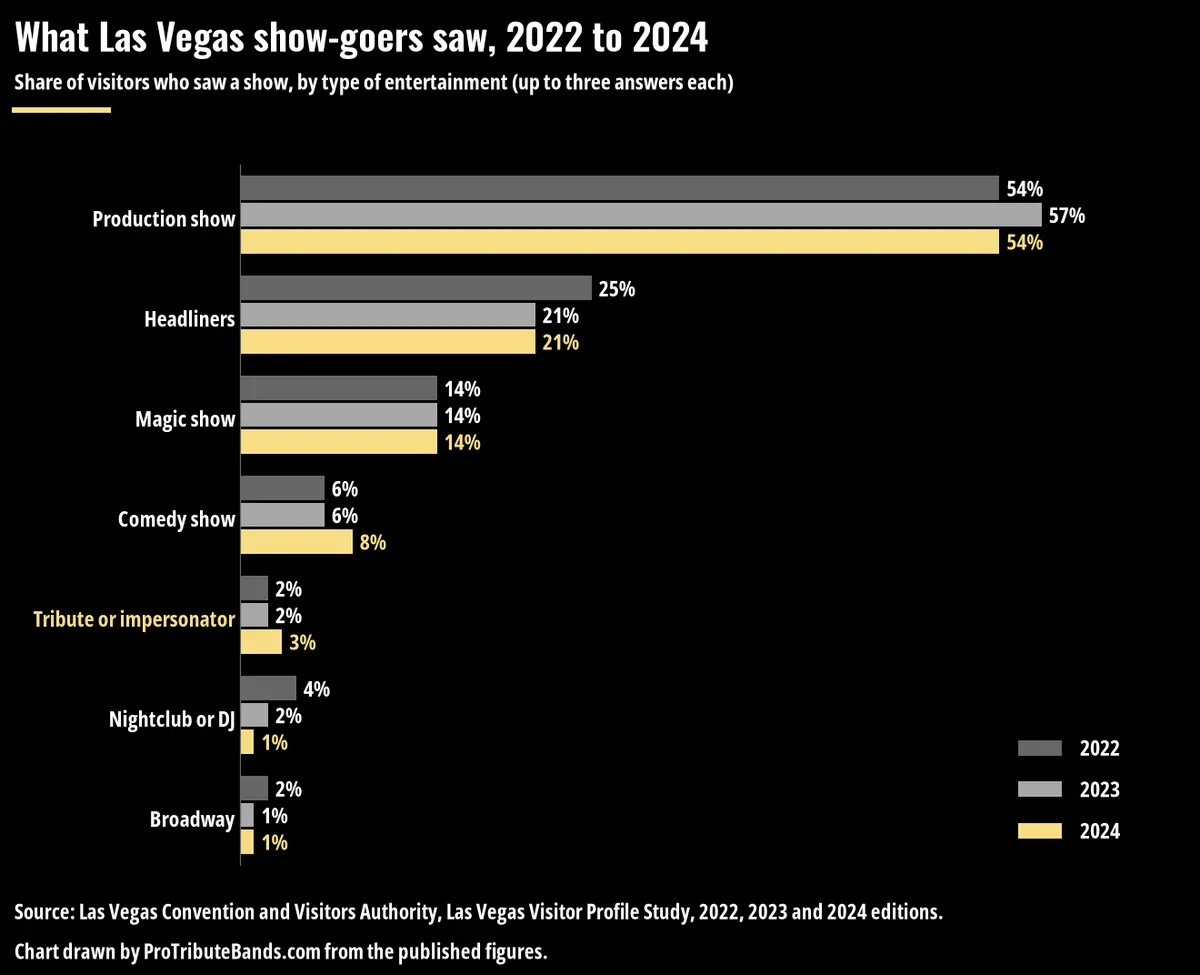
Figure 4: In the most crowded show market in the country, tribute and impersonator shows held 3% of show-goers in 2024, up from 2% in 2022 and 2023, in a market packed with resident production shows. Source: Las Vegas Convention and Visitors Authority, 2024 Las Vegas Visitor Profile Study , Mar 2025 (2024 data). Chart drawn by ProTributeBands.com from the figures the source published, 30 Sep 2026.
What do arts audiences spend around a show?
Plenty, and out-of-towners spend double. Nonprofit arts organizations and their audiences generated $151.7 billion in U.S. economic activity in 2022 (Americans for the Arts, Oct 2023). That study covers nonprofit arts only, so it fits PACs and concert series better than casinos.
Visitors matter most. About 30.1% of arts attendees came from outside the county where the event took place (Americans for the Arts, Oct 2023). Those nonlocal attendees spent an average of $60.57 per event, twice the $29.77 spent by locals (Americans for the Arts, Oct 2023). For 77% of them, the event itself was the main reason for the trip (Americans for the Arts, Oct 2023).
Commercial venues see it at the bar and the merch table. Fans at Live Nation’s U.S. amphitheater shows spent over $45 each on ancillary items in 2025, with onsite spend up 6% (Live Nation Entertainment, Feb 2026). Across the whole economy, arts and cultural activity accounted for 4.2% of U.S. GDP, or $1.17 trillion, in 2023 (U.S. Bureau of Economic Analysis, Apr 2025). For a presenter’s view, see my interview with Chris Carter of the Livermore Valley PAC.
Do Las Vegas and casino audiences buy shows?
Yes, though fewer did in 2024. About 21% of Las Vegas visitors attended shows or entertainment in 2024, down from 26% in 2023 (Las Vegas Convention and Visitors Authority, Mar 2025).
Among those who did, 54% saw a production show, 21% a headliner and 3% a tribute or impersonator show (Las Vegas Convention and Visitors Authority, Mar 2025). Context matters. That 3% is a share of show-goers in the most crowded show market in the U.S., where tribute acts compete with resident spectaculars and superstar residencies.
The city itself cooled a bit. Las Vegas drew 38.5 million visitors in 2025, down from 41.7 million in 2024 (Las Vegas Convention and Visitors Authority, Mar 2026). Visitors spent $50.8 billion in Southern Nevada in 2025, down 7.8% from 2024 (Las Vegas Convention and Visitors Authority, Jul 2026).
How big is the fair audience?
Nearly 98 million visits a year. U.S. fairs drew 97.9 million visitors across 1,392 fairs in 2024 (International Association of Fairs and Expositions, Sep 2025). That’s a trade association measuring its own industry, partly through phone location data, so take the totals as its best estimate.
The money follows the crowds. Fairs have a $30 billion economic impact and generate $10 billion in wages (International Association of Fairs and Expositions, Sep 2025). Fairgrounds host far more than the fair itself. About 65% of the U.S. population attends an event at a fairground during the year (International Association of Fairs and Expositions, Sep 2025).
Big fairs are economic engines. Fairs drawing over 1 million people average $585.5 million in local economic impact (International Association of Fairs and Expositions, Sep 2025). A grandstand night with a band the whole county knows is an easy sell. If you’re sorting out staging, our guide to indoor vs outdoor venues covers the setup, and choosing the right tribute band for your event covers the act.
Booking for a PAC, a fair board or a casino? Tell us your date. We’ll match you with the right act.
What do corporate and wedding buyers want from live entertainment?
Corporate planners are chasing memorable experiences and couples are chasing value, and both are paying more for everything around the music.
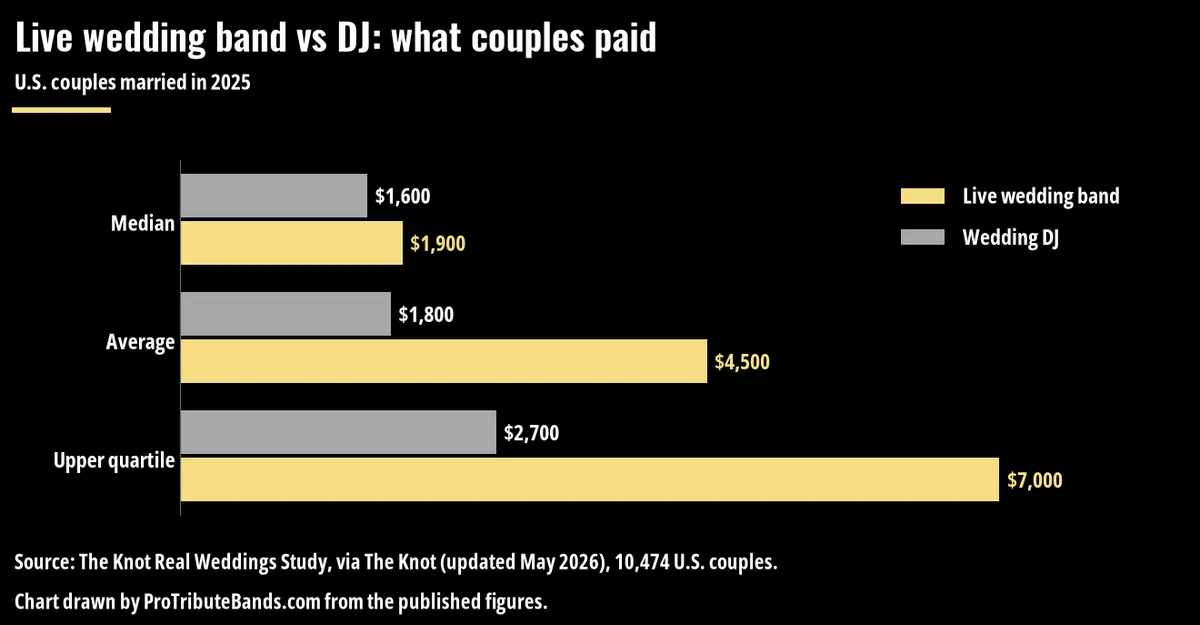
Figure 5: A live band costs more than a DJ at every price point, but the gap is narrow at the median and wide at the top, so the band you hire decides which end of the chart you’re on. Source: The Knot, The Average Wedding DJ Cost vs. the Average Live Wedding Band Cost , May 2026 (couples married in 2025). Chart drawn by ProTributeBands.com from the published figures, captured 30 Sep 2026.
What do corporate event planners prioritize?
Memorable experiences come first. Costs are climbing too. In a global survey of 601 meetings and events professionals, 71% expect costs to rise in 2026 (American Express Global Business Travel, Oct 2025). The survey was run for a corporate travel company and fielded in eight countries, so treat it as a global mood check.
The mood is upbeat, though. About 85% of meeting professionals are optimistic about the sector in 2026 (American Express Global Business Travel, Oct 2025). Cost is still the worry, with 38% naming it their No. 1 challenge (American Express Global Business Travel, Oct 2025).
The industry is huge. Business events are a $1.6 trillion global industry, measured on a 2019 baseline (Events Industry Council with Oxford Economics, May 2023). Organizers estimate they’d lose an average of 44% of revenue without in-person events (Events Industry Council with Oxford Economics, May 2023).
Vegas shows what they’re worth. The city hosted 6.0 million convention attendees in 2025 (Las Vegas Convention and Visitors Authority, Jul 2026). Those convention visitors spent $1,795 per trip, 45.9% more than leisure visitors (Las Vegas Convention and Visitors Authority, Jul 2026). Our guide on how to choose a tribute band for a corporate event walks through the details, and when you’re ready, browse our tribute bands for corporate events.
What do couples spend on wedding music?
Less than you’d guess. Most hire a DJ. The median wedding band costs $1,900, and the upper quartile reaches $7,000 (The Knot, May 2026). The average and the median sit far apart, so look at both. Price was couples’ main deciding factor when choosing wedding music (The Knot, May 2026).
The wedding budget around the music holds steady. The average U.S. wedding cost $34,000 in 2025, or $292 per guest (The Knot Worldwide, Feb 2026). The average wedding had 117 guests and used 13 wedding professionals (The Knot Worldwide, Feb 2026).
The market is steady too. About 2 million U.S. couples married in 2025 (The Knot Worldwide, Feb 2026). Federal counts sit in the same range, with 2,041,926 marriages recorded in 2023, provisional, a rate of 6.1 per 1,000 people (CDC National Center for Health Statistics, Mar 2025).
Most couples don’t regret the spend. Three in four say their wedding was financially worth it (The Knot Worldwide, Feb 2026). A national-caliber tribute act sits well above these averages. It’s a different product from a local wedding band. For song ideas, see the most popular wedding songs by decade, and to find an act, browse our tribute bands for weddings.
Methodology and Sources
Every number on this page comes from the organization that produced it: government agencies, company filings, peer-reviewed research, and research firms publishing their own data. Each one carries its date. Figures I couldn’t trace back to an origin were left out. All data is U.S. unless labeled. Live Nation, the Events Industry Council and American Express Global Business Travel report global figures, and the tribute pricing study covers Germany. This page is refreshed monthly, starting with the consumer price index line.
Sources
- Live Nation Entertainment, Inc., Form 10-K, fiscal year ended December 31, 2025, February 2026.
- Live Nation Entertainment, Inc., Live Nation Entertainment Reports Second Quarter 2026 Results, July 30, 2026.
- National Endowment for the Arts, By All Means, the Arts: A Full Report of the 2022 Survey of Public Participation in the Arts, August 2025 (2017 and 2022 survey data).
- U.S. Bureau of Economic Analysis, Arts and Cultural Production Satellite Account, U.S. and States, 2023, April 2, 2025.
- Nielsen, The Record: Q1 U.S. audio listening trends, June 2026.
- Nielsen, Audio Today 2026: How America Listens, March 2026.
- Luminate, 2026 Midyear Report (Music, TV and Film), July 2026 (first half of 2026 data).
- Luminate, A look at trends in Catalog Streaming, August 15, 2023.
- Sphere Entertainment Co., Form 10-K, fiscal year ended December 31, 2025, February 2026.
- Samuel Cameron and Hendrik Sonnabend, Economics Bulletin, Pricing in live music: an empirical analysis of the tribute band sector, Vol. 40, Issue 2, April 2020 (German tribute concerts, 2015 to 2019).
- U.S. Bureau of Labor Statistics, Consumer Price Index, August 2026, September 11, 2026.
- U.S. Bureau of Labor Statistics, Consumer Expenditures, 2024, December 19, 2025.
- U.S. Bureau of Labor Statistics, Occupational Outlook Handbook: Musicians and Singers, May 2025 wage data, 2025 to 2035 projections.
- Americans for the Arts, Arts and Economic Prosperity 6, October 2023 (2022 data).
- Americans for the Arts, AEP6 Key Messages and Findings, October 2023.
- Las Vegas Convention and Visitors Authority, 2024 Las Vegas Visitor Profile Study, March 2025 (archived by the Nevada State Library).
- Las Vegas Convention and Visitors Authority, Las Vegas Historic Tourism Statistics, 1970 to 2025, March 2026.
- Las Vegas Convention and Visitors Authority with Applied Analysis, The Economic Impact of Southern Nevada’s Tourism Industry, July 2026 (2025 data).
- International Association of Fairs and Expositions, Economic Impact Study: National Summary Report, September 2025 (2024 data).
- American Express Global Business Travel, 2026 Global Meetings and Events Forecast, October 2025 (survey fielded by YouGov, July 2025).
- Events Industry Council with Oxford Economics, Global Economic Significance of Business Events, May 22, 2023 (2019 baseline).
- The Knot, The Average Wedding DJ Cost vs. the Average Live Wedding Band Cost, updated May 6, 2026.
- The Knot Worldwide, The Knot Worldwide Unveils 2026 Real Weddings Study, February 18, 2026.
- CDC National Center for Health Statistics, FastStats: Marriage and Divorce, reviewed March 17, 2025 (provisional 2023 data).
Glossary
- PAC: Performing arts center, a venue, often municipal or nonprofit, that presents touring shows and concert series.
- NEA: National Endowment for the Arts, the federal agency that runs the national arts attendance survey.
- SPPA: Survey of Public Participation in the Arts, the NEA’s national arts attendance survey, fielded with the U.S. Census Bureau.
- BLS: U.S. Bureau of Labor Statistics.
- CPI: Consumer Price Index, the BLS measure of price change for consumer goods and services.
- OOH: Occupational Outlook Handbook, the BLS guide to pay and job counts by occupation.
- BEA: U.S. Bureau of Economic Analysis, which measures the arts share of GDP.
- AEP6: Arts and Economic Prosperity 6, the Americans for the Arts study of nonprofit arts spending (2022 data).
- LVCVA: Las Vegas Convention and Visitors Authority.
- IAFE: International Association of Fairs and Expositions.
- Catalog and deep catalog: Luminate’s terms for older recordings. Catalog means released more than 18 months ago, and deep catalog is an older subset.
- Headliner vs production show: LVCVA categories for a named star act vs a resident produced show.
- Routed date: A booking on a date when the band is already touring nearby.
- Flyout date: A one-off booking that requires flying the band in.
- Get-in price: The cheapest ticket available for a show.